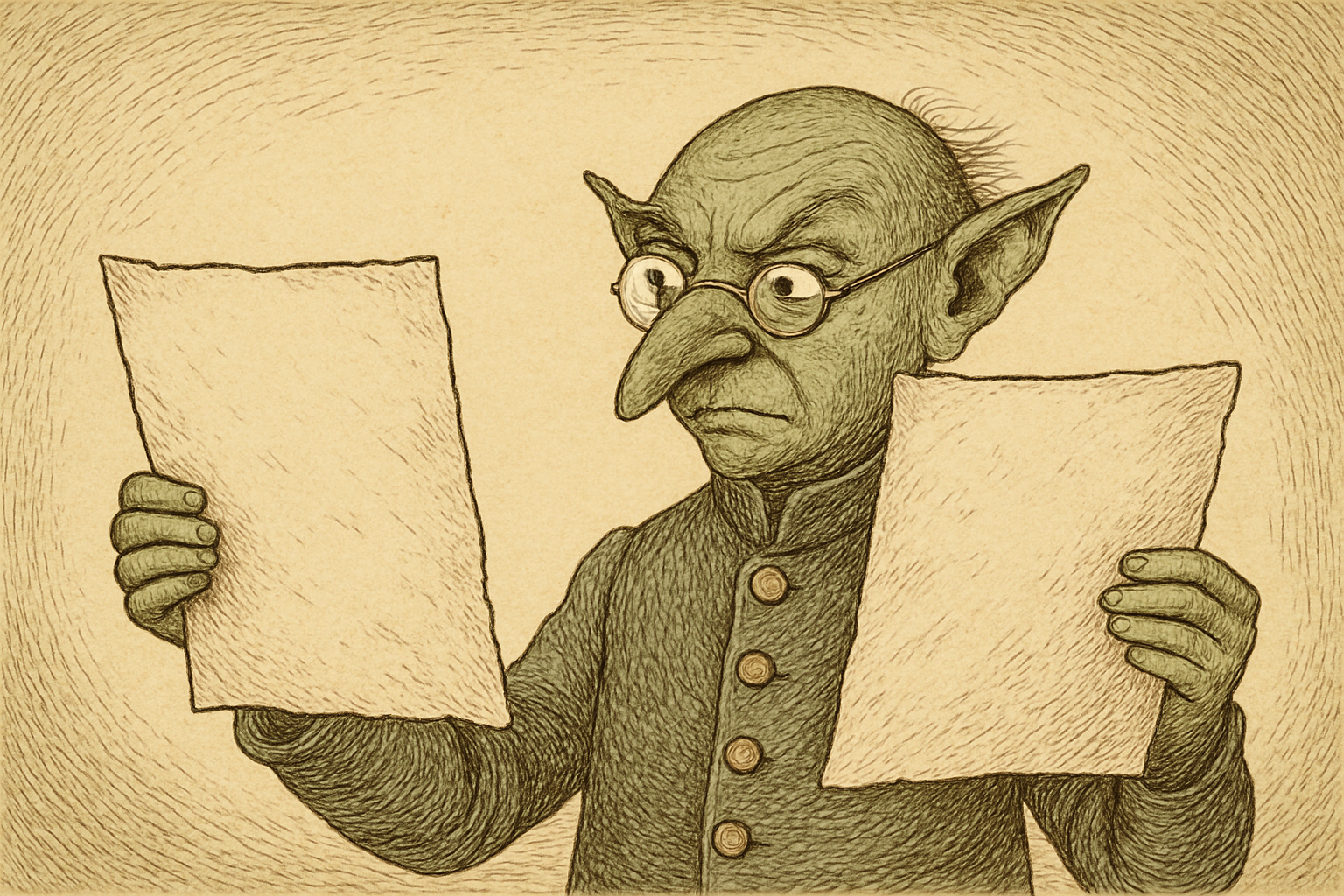
The phrase duplicate content penalty is one of those things people repeat to each other so often that it has acquired the texture of truth. The Goblin would like to gently correct it: there is no duplicate content penalty. There is, however, a duplicate content problem, and it costs small shops more traffic than they realise.
Why the “penalty” is a myth.
Google has said, on the record and repeatedly, that it does not penalise sites for having duplicate content. What it does is choose, when faced with two pages that look broadly identical, which of them to rank. It picks one; the other is buried.
This is not a punishment. It is a sorting decision. But for the shopkeeper whose page is the one Google decides not to surface, the practical effect is indistinguishable from a penalty: their page does not appear in the search results.
Where duplicate content comes from on a small shop.
Four common sources, in roughly the order the Goblin encounters them.
- Manufacturer descriptions copied verbatim. If you sell a thing that twenty other shops also sell, and you all copied the same description from the supplier’s PDF, you are all running duplicate content. Google will pick one shop to rank. It will not be the smallest one.
- The same product listed under multiple categories. A leather notebook in “notebooks,” in “leather goods,” and in “gifts” can produce three URLs serving the same content. Shopify handles this gracefully with canonical URLs by default, but other platforms do not always.
- Filter and sort URLs. When a customer filters a collection by colour, size, or price, the URL changes. Each filtered URL can technically be indexed by Google. The page’s content is broadly the same. The Goblin has audited shops with two hundred indexed pages that are, in effect, the same page twenty different ways.
- Slightly varied product pages. Two products that differ in size or colour, given near-identical descriptions, will compete for the same searches and confuse Google about which one matters.
The fixes.
Three, in order of effort.
First, rewrite manufacturer descriptions in your own words. The Goblin has written about this at length elsewhere; suffice to say it is the single most effective antidote to duplicate-content problems, and it usually improves conversion too.
Second, verify your canonical tags. Shopify does this automatically; on other platforms you may need to check. A canonical tag is a small line in the HTML of a page that tells Google “this page is a variant of that other page, please rank that other one.” If your filter URLs all have a canonical pointing to the unfiltered collection page, Google will sort itself out.
Third, use Google Search Console to look at the “Coverage” report and see how many of your pages Google has indexed. If the number is significantly higher than your actual page count, you have a duplicate-URL problem, and a canonical-tag audit will fix it.
Duplicate content is one of the rare SEO topics where the panic exceeds the reality. There is no penalty; there is only a sorting problem. The shopkeeper who rewrites their descriptions, verifies their canonicals, and stops worrying about the word “penalty” will, in nearly every case, find their traffic improves.
The Goblin will, if commissioned, tell you specifically which of your pages are competing with each other for the same search.
— The Goblin, with two suspiciously similar pages in front of him.