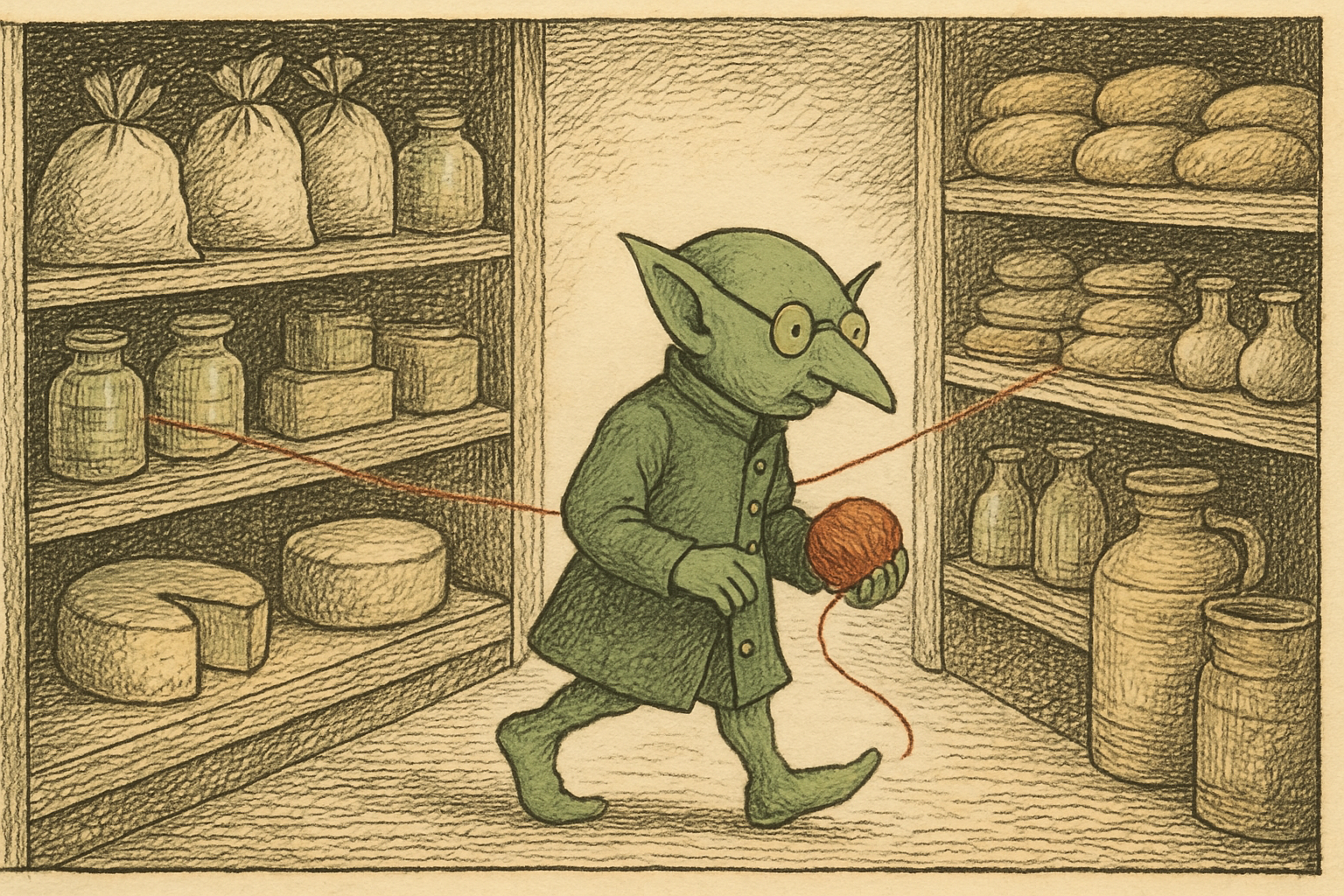
Internal links are the cheapest improvement available to a small online shop, and the most consistently neglected. The Goblin does not entirely blame the shopkeeper for this. The work is dull, the rewards are quiet, and the SEO blogs that ought to be teaching it are usually selling apps that do something else.
So let us, briefly, talk about what an internal link does, and why the absence of them on most product pages is costing you traffic the Goblin would prefer you kept.
What an internal link is, and what it is not.
An internal link is a link from one page on your shop to another page on your shop. The navigation menu is internal linking. The footer is internal linking. So is “you may also like,” if your theme has that. So is a hand-written reference in your description that says this notebook is also available in green.
What an internal link is not: a link from your shop to Amazon, Etsy, Instagram, or your own portfolio. Those are external links. They are not without value, but they are not the subject of this article.
Why Google cares.
Google reads the links between your pages and uses them to do two things. First, it figures out which of your pages are important; pages that many other pages link to are inferred to be your priorities. Second, it figures out which pages are about what; the words you use in the link itself give Google a clue.
A product page that is linked to from your home page, your collection page, and three other product pages is, in Google’s estimation, a page that matters. A product page that is linked to from one collection page and nothing else is, in Google’s estimation, just another stocking-filler. The two pages may have identical product copy and identical photographs, and yet they will rank differently. The Goblin has watched this happen many times.
What the absence of internal linking looks like.
The Goblin opens a product page, scrolls to the bottom, and counts what he sees. On a typical small shop the answer is: a footer, and nothing else. No related products, no “goes well with,” no link to the maker’s story, no link to the collection this product belongs to, no link to the matching item in green. The page is, in effect, a dead end.
A dead-end product page is fine for the customer who arrived intending to buy that exact item. It is not fine for the customer who arrived browsing, or for Google, who relies on links to understand your shop’s structure.
The fix, which takes an afternoon.
Three changes, in order of importance.
- Add a “goes well with” module at the bottom of every product page. Three to five hand-curated related items. Not algorithmically chosen; hand-chosen, once, by you. Each item shows a thumbnail, a title, and a price. Each title links to the relevant product page.
- Inside the description, link to one or two related things in plain prose. “This notebook pairs with our refillable fountain pen, which we recommend if you have small handwriting.” The phrase “refillable fountain pen” is the link, and it tells Google what the linked page is about.
- Link from your collection page to your “maker’s story” or About page, in the description text. This is the single internal link most shops do not have and Google would benefit from seeing.
The mistakes to avoid.
Two specifically. First: do not use “click here” or “learn more” as the link text. Use the words that describe what the link goes to. The Goblin has read every variant of “click here” in his career and he is, frankly, tired.
Second: do not pay an app to do this for you, at least not on a small shop. Apps that auto-generate related products often choose poorly, slow your site, and waste an opportunity for the human curation that customers actually prefer. The Goblin’s rule: if it would take you an afternoon to do by hand, do it by hand.
Internal linking is one of those rare tasks where the work is genuinely simple, the impact is genuinely real, and the only thing standing between you and the improvement is an afternoon of clicking around your own shop. The Goblin recommends you spend the afternoon. He will, if commissioned, tell you which links to add, on which pages, in what order.
— The Goblin, with a small ball of red string.