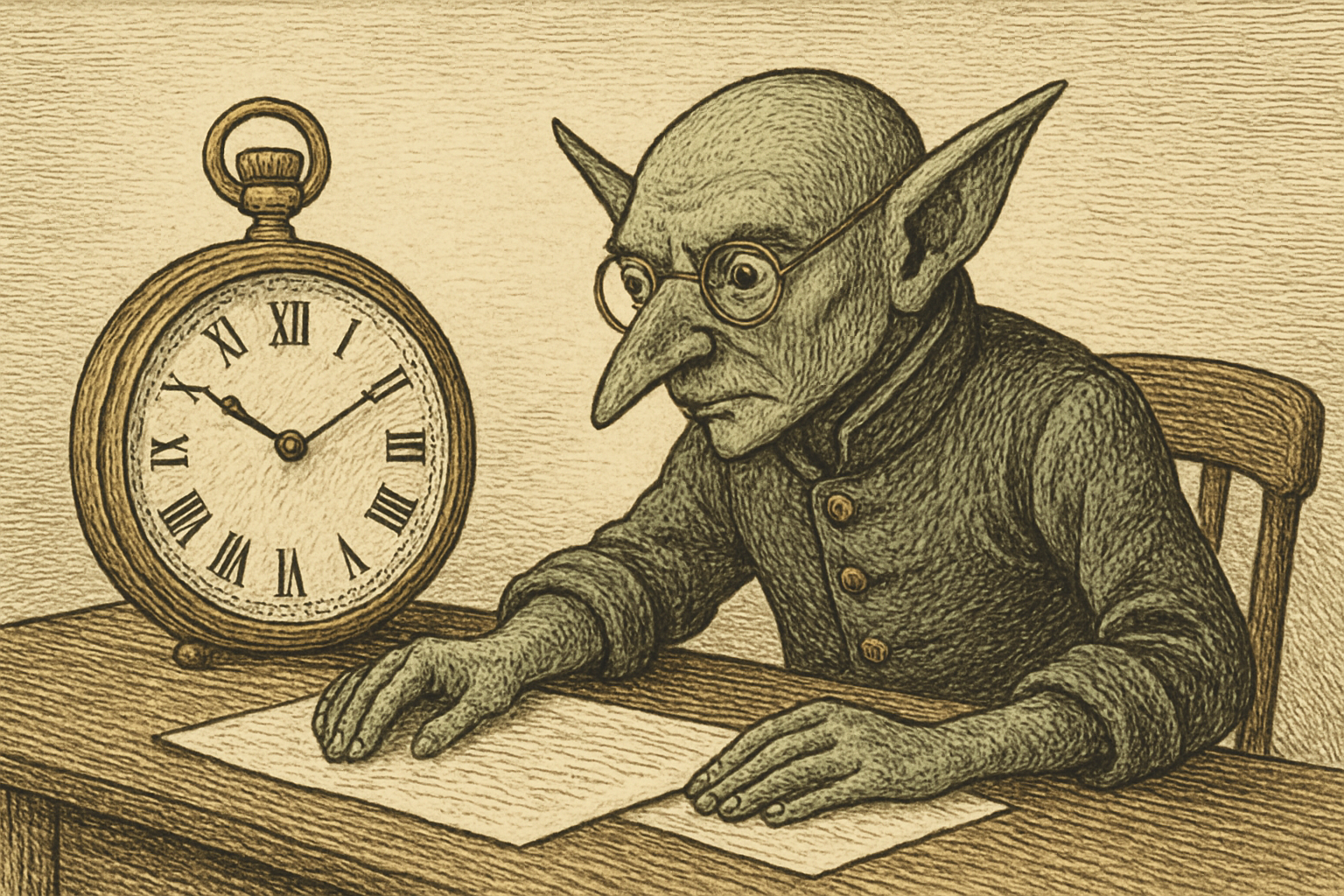
Every audit begins the same way. You submit your shop. I get the email at, usually, an hour I find inconvenient. I make tea. I open your home page in a fresh browser, with no tabs, no distractions, no prior knowledge of you. I sit, and I look, for exactly three minutes.
What I am doing in those three minutes is the most important part of the audit. The next twenty-three hours are spent confirming, expanding, and writing up the impressions I formed in the first three. This is not laziness; it is the discipline of the cold read. By the fourth minute I will have formed assumptions that are difficult to undo. By the fifth, I will have already started writing the audit, in my head, and the cake will largely be baked.
So those three minutes. What am I looking for?
The first ten seconds: do I understand what this shop sells?
I have written elsewhere about the depressing frequency with which the answer is “no.” In the first ten seconds I am scanning the hero — the headline, the subhead, the photograph, the button — for an answer. If I do not have one, I make a note. Grumble: home page does not communicate category. The audit will, on page two, gently remind you of this.
The next thirty seconds: who am I?
If the shop has done its job in the first ten seconds, it has earned the next thirty. Now I want to know who made this. Is there a person behind it? Is there a place? Is there a story I can latch onto? Or is this another faceless storefront, indistinguishable from the dropshippers selling the same item on Amazon for half the price?
I am looking for the About link. I am looking for a paragraph somewhere on the home page that says made in Devon or family business since 1998 or I started this because. If I cannot find any of it, I make a second note. Grumble: no human visible. Sole-trader shops with no human visible are, in 2026, harder to trust than they were five years ago.
The next thirty seconds: how navigable is this?
I look at the menu. I try to figure out, without clicking, what the categories are. I read the words you have used. Are they words a customer would use? Or are they internal-speak — “Collections,” “Shop the Look,” “Curated” — which sound nice in a marketing meeting but mean nothing to the person who searched for “leather notebook”?
If the menu uses your jargon, the shop will rank for your jargon, which nobody searches for. I take a note. Grumble: category names not aligned with customer search behaviour.
The next minute: I click on one thing.
I pick a product, almost at random, and I open it. I am now on a product page. I am looking at the photograph, the title, the price, the description, the buy button. I am also, more importantly, looking at the URL, and at the title tag (which I have a browser extension that surfaces for me).
I am asking: Does this page do its job? The job of a product page is to convert a curious visitor into a buyer, or, failing that, to convert them into someone who remembers your shop in a week. Either is fine. Neither happens, however, if the page is dull.
The most common failure: the photograph is grand, and everything else is an afterthought. The description is the manufacturer’s blurb. The title is the SKU. There is no internal linking. The shop has spent on photography what should have been spent equally on copy.
The last twenty seconds: I look at the footer.
This is, perversely, where I learn the most. The footer is where the shop’s priorities are revealed. Newsletter signup? Returns policy? Contact? Reviews? Social proof? Care instructions? Or twelve identical “Quick links” that all point to the same three pages?
The footer tells me whether the shop owner has thought about what a doubtful customer needs to do next. Most footers, I am sorry to report, have not thought about this at all.
By three minutes, I have between seven and twelve notes. By five minutes, I have an outline of the audit. By an hour, I have the structure of the PDF. The next twenty-two hours are spent verifying, finding the things I missed in my haste, and writing the document with the care a small shop deserves.
None of this is magic. Most of it is paying attention with a stopwatch on. You can do it yourself. The reason you do not, and the reason I do this for nineteen dollars, is that you are looking at your shop with affection and I am looking at it with the cold eye of a Victorian shopkeeper who has seen this trick before.
— The Goblin, with tea.