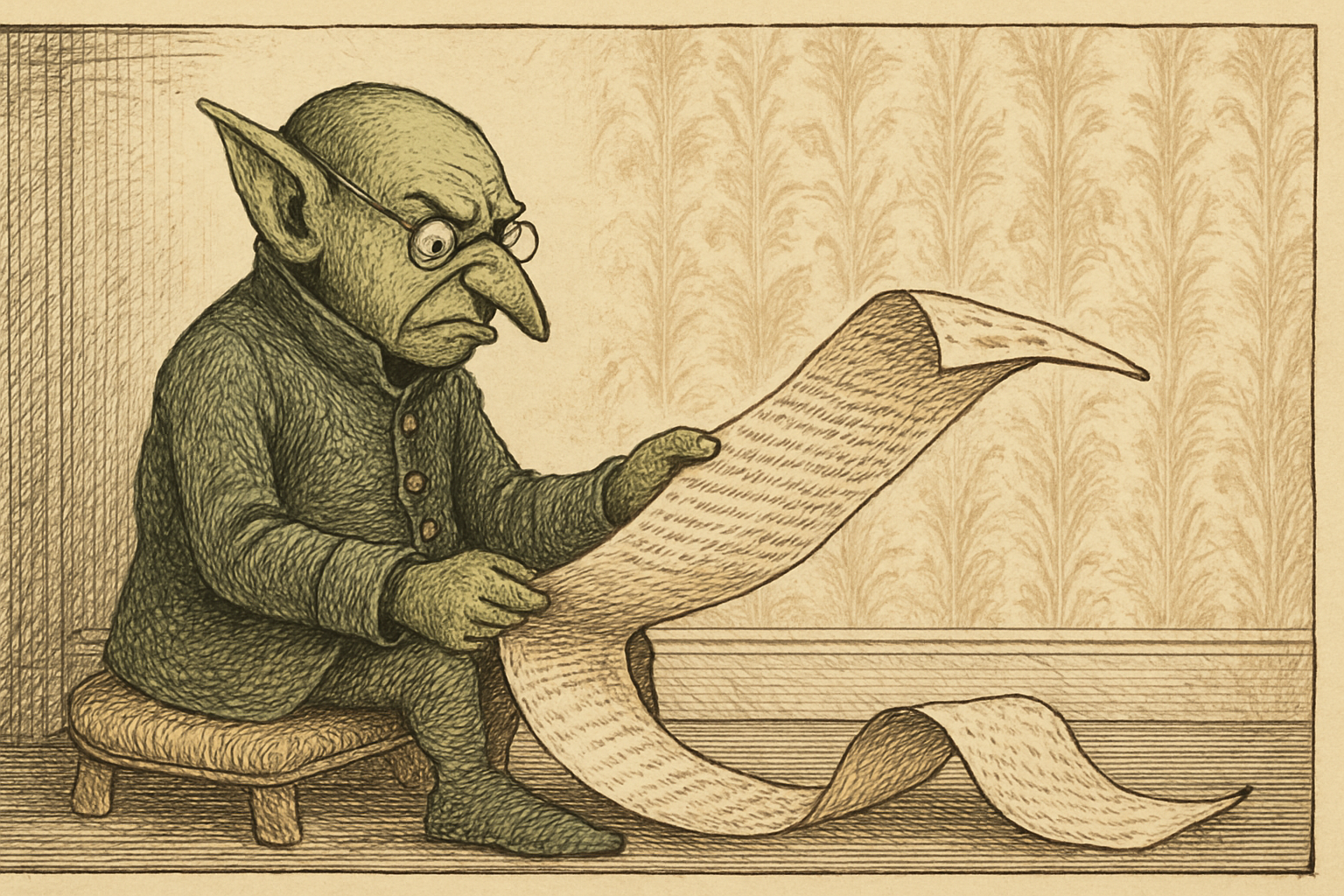
I have, by my own slightly defensive estimate, looked at something close to eleven thousand small shops over the years. The first three thousand were a delight, in the way that all novelty is. After that, a pattern. After that, a more concerning pattern. After that, a sense that I might be losing my mind.
What follows is the pattern. Five grumbles I find in nearly every Shopify storefront I audit, in roughly the order I notice them, with a note on how to fix each. The Goblin grows tired of repeating himself, but the alternative — letting them go unsaid — is, frankly, intolerable.
I. The home page does not say what the shop sells.
You laugh. I do not. In the first three minutes of an audit I read the home page top to bottom and ask myself, in plain English, what is being sold here. A surprising proportion of shops — well above half — do not give a clear answer in the visible content above the fold.
The hero says “Discover authentic craftsmanship.” The subhead says “Curated with care.” The button says “Shop now.” I am asked to shop, but I have not been told what for. Is this candles? Is this leather goods? Is this something edible?
The fix is mortifying in its obviousness. State, in the hero, what you sell. “Handmade beeswax candles, made in Devon.” “Solid walnut bookcases, built to order.” “Sourdough starter, posted by first-class mail.” The category, the material if relevant, the place if relevant. A sentence. No more.
II. The product titles begin with the shop’s name.
I open Google. I search for a leather notebook. I see, in the results, a page titled “Marlow & Daughter — The Edition Notebook.” I do not yet know who Marlow & Daughter are. I do not, yet, care. I scroll past the title, looking for the word notebook.
The shop has spent ten characters of the most valuable real estate it owns telling me its name, which is meaningless to me at this moment, and only after that telling me what the thing is. Google looks at the title and forms its opinion. The customer looks at the title and forms theirs. Both opinions are formed before the shop’s name has any opportunity to matter.
The fix: put the thing first. “The Edition Notebook — full-grain leather, A5, by Marlow & Daughter.” In your title tag (the one Google reads), and in your product page H1 if you are bold. Reserve the shop’s name for the suffix, where it can earn its keep over time.
III. Every product image is named IMG_0473.jpg.
Or DSC_8841.jpg. Or 2025-03-14T16.21.03.heic. The phone’s default filename, uploaded directly into the storefront, never renamed. Google has been given no help in understanding what the image depicts; the image itself has no opinion; and you are, in a small and silent way, throwing away a perfectly free signal.
The fix: rename every image before you upload it. “walnut-bookcase-three-shelf-front.jpg.” “beeswax-pillar-candle-lavender.jpg.” Hyphen-separated, lowercase, no spaces, no special characters. And while you are at it, give each image an alt description that an actual person could read aloud. The Goblin, who has audited blind shoppers as well as sighted ones, takes this seriously.
IV. The product description is copied from the supplier’s PDF.
I have written elsewhere about product descriptions that read like the manufacturer’s PDF, and I will not repeat the full tirade here. Suffice to say: if your description begins with “Features:” followed by bullet points, and uses the word features more than twice, you have copied the supplier’s sheet, and so has every dropshipper currently outranking you.
The fix: rewrite each description in the voice of the person who would actually use the thing. Not a marketer. The person. Two or three sentences about who it’s for, what it does, what it feels like in the hand. The specs come at the end, in a small table, not at the top in a bullet list. Google likes this better. Customers like this far better.
V. There is no internal linking between related products.
You sell a notebook. You also sell a pen. You also sell ink. The notebook page does not link to the pen page, the pen page does not link to the ink page, and the ink page does not, of course, link back. Three perfectly nice product pages, none of them aware of the others, leaving the customer to navigate by the strength of their own memory and the menu bar.
The fix: add a small “Goes well with” module at the bottom of every product page. Three to five hand-chosen related items, with images and prices. Yes, you can use a Shopify app for this; no, the algorithmic ones do not work as well as a human curating the relationships once and being done with it. Google reads these links and uses them to understand which products belong together. Customers read these links and add a second item to the basket. Everyone profits, including, modestly, the Goblin.
If you are looking at your own shop while reading this and recognising one or two of these, that is normal. If you are recognising all five, that is also normal, and the Goblin is not surprised. He audits eleven thousand shops; you have audited one; he has had longer to develop opinions about it.
The good news is that all five are fixable in an afternoon. The slightly less good news is that there are usually another twelve issues hiding behind these five, which is why we wrote the full audit in the first place.
— The Goblin, with an apology to any parrots reading.