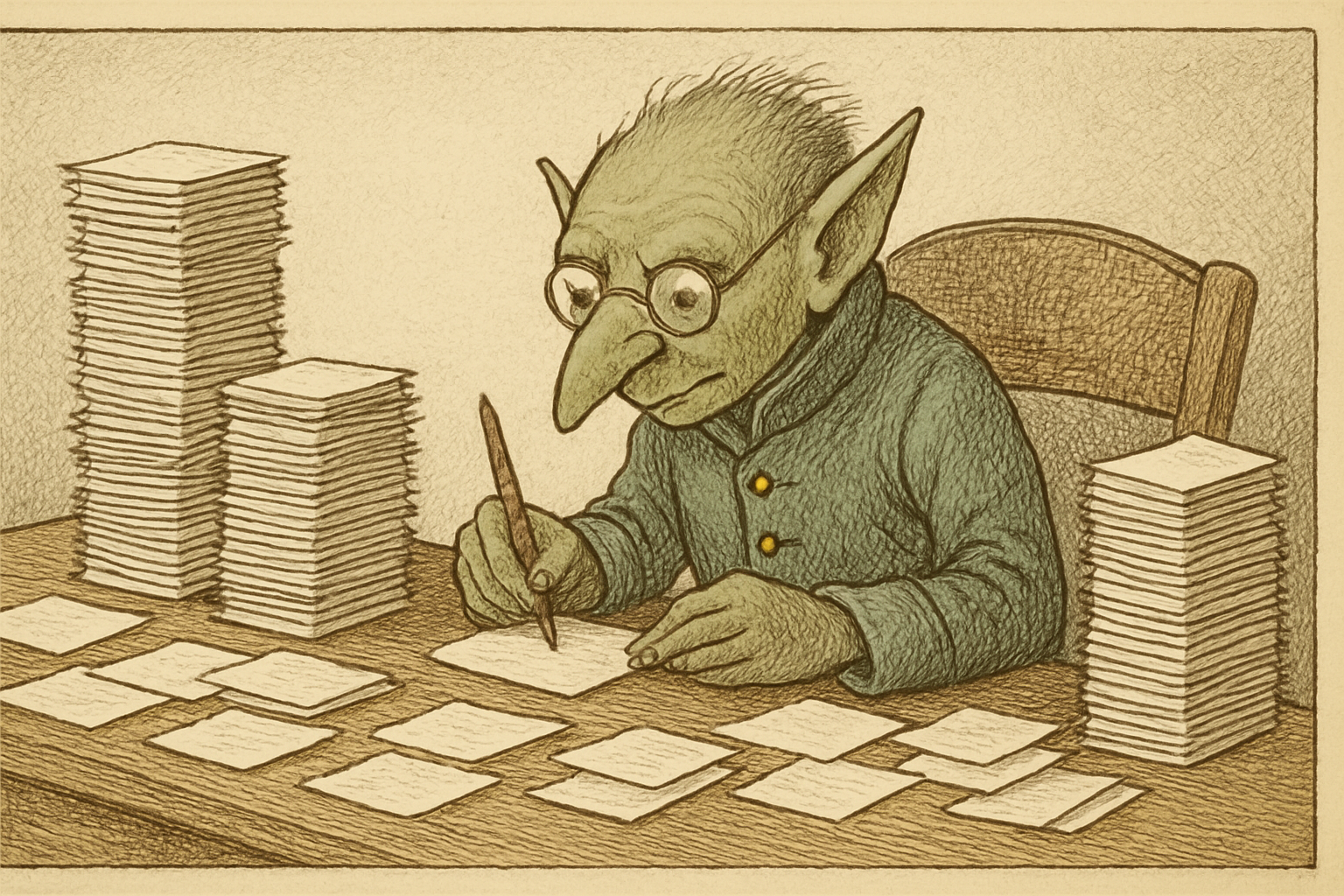
Keyword research, as practised by the modern SEO industry, involves a subscription to a tool that costs as much per month as a small shop’s entire marketing budget. The Goblin would like to suggest, gently, that this is not necessary.
Here is how he does it, with no tool at all.
Step one: open Google.
Type the first word that a customer might use to find your product. Watch what Google autocompletes. Those autocomplete suggestions are not opinions; they are what other people have searched for, in volume sufficient for Google to remember. The Goblin’s favourite source of keyword data has always been Google’s own search box.
Try variations. “Leather notebook,” “leather notebook A5,” “leather notebook gift,” “leather notebook personalised.” Each autocompletion is a phrase Google has data on. Write them down.
Step two: scroll to the bottom of the search results.
At the bottom of every Google results page is a block called “Related searches.” These are phrases Google considers semantically adjacent to what you searched for. They are gold. Write them down too.
Also note the “People Also Ask” box, if one appears. Each question is a phrase a meaningful number of people have typed. Each answer is an opportunity to write a paragraph somewhere on your shop that addresses it.
Step three: read the reviews on Amazon.
This sounds like a digression but is, in the Goblin’s experience, the single most useful free source of keyword data available. Find the Amazon listings for products like yours. Read the customer reviews. Note the exact phrases customers use to describe what they wanted, what they got, and what they liked.
Those phrases are, almost without exception, the phrases your customers search for. Customers use the same language to search as they use to review. The Goblin once watched a shopkeeper double her traffic in a quarter simply by inserting three review-derived phrases into her product titles.
Step four: ask your customers.
If you have repeat customers, email five of them. Ask: “If you were searching for this product on Google today, what would you type?” You will be surprised how few of them type the words you use in your shop.
The mismatch between shopkeeper language and customer language is, the Goblin would argue, the single most expensive mistake in small-shop SEO. Tools can hint at it. Customers will tell you directly.
Step five: search for the phrases you have written down, and see who ranks.
For each phrase, type it into Google and look at the top five results. Are they shops like yours? Big brands? Aggregators? If the top five are all enormous retailers, the phrase is too competitive for a small shop and you should pick a different one. If the top five include a couple of independent shops, the phrase is reachable.
This is, in essence, what an expensive keyword tool does for you. The tool also estimates monthly search volume, which is useful but not essential; the autocomplete itself tells you whether a phrase has volume (if it autocompletes, it has enough volume to be remembered).
None of this requires a subscription. None of this requires a Pro plan. The whole process takes an afternoon and produces a list of ten to twenty phrases your customers actually search for. Those phrases, dropped sensibly into your product titles, descriptions, and collection pages, will move more traffic than any tool dashboard.
The Goblin will, if commissioned, do this exercise for you and hand you the list. The list is in the audit, under “keyword opportunities.”
— The Goblin, who has never paid for a keyword tool.